
Writing is challenging and vulnerable work. Synthesizing everything you know and understand about a topic into a cohesive text appropriate for the audience and the task can leave you staring at a blank page—even when that page is in a private journal intended only for its author. Sharing an “in-process” or “final” product with someone else takes courage, too—even within relationships and classrooms we hope students experience as safe spaces.
And yet, from the beginning of the school year, we often invite our students to share their experiences and perspectives with us, particularly through personal narratives, in spaces that haven’t yet developed into places of interdependence, belonging, and care. Because writing is such a familiar part of school, it can be easy to focus on the skills students are demonstrating and overlook the vulnerability involved in sharing something they have created.
Those of us who have written with and for students often bring years of experience and confidence to the process. We have had countless opportunities to write for different audiences and purposes, to receive feedback, to revise, and to discover what it means to share our words with others. Our students are still developing those experiences. How many years have they been writing? Who have they been writing for? What classroom environments have shaped their experiences with writing?
For some of our students, writing is fraught with risks they are not willing to take. And if they have been presumed incompetent because of their identities—created by a combination of social, personal, and/or other types of markers—they have experienced instruction riddled with obstacles that make teachers’ efforts to facilitate their development of an asset-centered writing identity hard.
As a Black educator still working to interrupt the negative voices that constrict my creative freedom and often impede my ability to share my work, I empathize with children learning to write and intentionally seek and celebrate the messages communicated in their writing. My K–12 experiences with writing were affirming and nurtured in me a strong writing identity. An undergraduate creative writing instructor and a graduate literacy professor who each chose to respond to my writing with negative, public feedback damaged my perception of myself as a writer. Being the only Black student in the first setting and one of two Black women—both recipients of negative, public feedback—in the second still affects me over a decade later, making me understand even more deeply the challenges faced by young learners who are harmed by a deficit approach during their formative years.
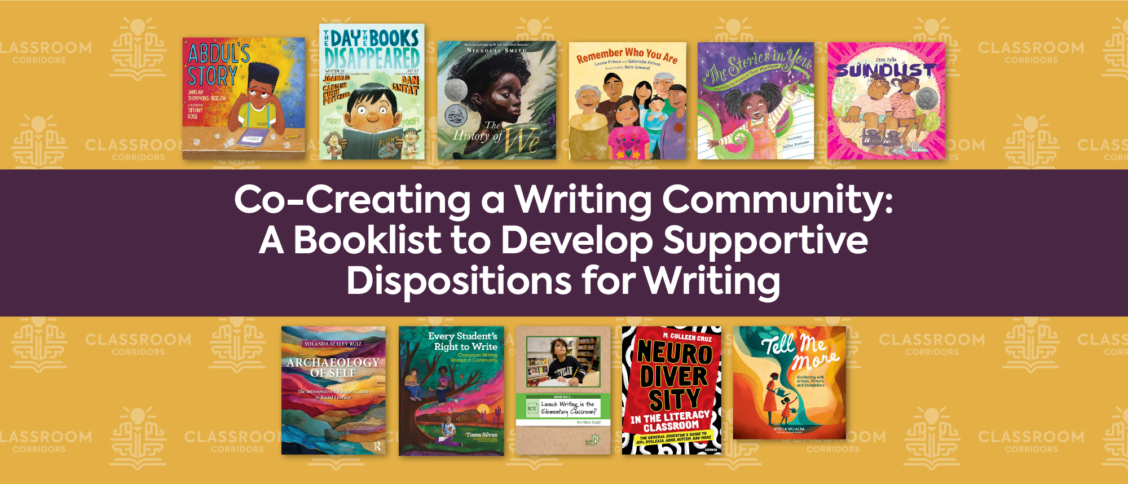
For this reason, I suggest five texts as tools and resources for the personal and professional work educators need to engage in to provide a safe space for their learners and co-create accessible, engaging, and inclusive writing communities. Following that annotated list are six trade book titles with explanations of how the professional resources can support the use of these titles in the classroom.
Professional Texts: Featured Title
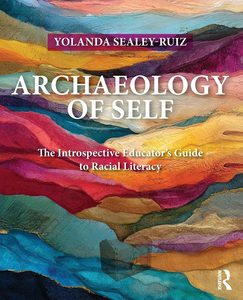
Archaeology of Self: The Introspective Educator’s Guide to Racial Literacy
By Yolanda Sealey-Ruiz
Archaeology of Self is Dr. Sealey-Ruiz’s full-length treatment of her framework, providing both theory and examples of application. Excavating and interrogating ourselves, including our experiences as former students and current teachers, helps us learn how we come to the beliefs we hold and why we take the actions we choose. The book supports this process through personal stories Dr. Sealey-Ruiz shares about her own journey and artifacts from students who have engaged in their own journeys using her framework. Of particular relevance to developing the writing spaces many of us did not but should have had is Part Three, which delves into the personal and collective healing teachers and leaders need to do not only for themselves, but also for their students.
Additional Recommended Titles
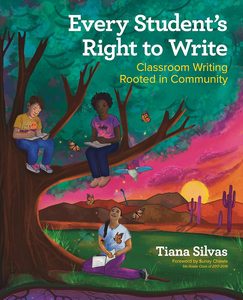
Every Student’s Right to Write: Classroom Writing Rooted in Community
By Tiana Silvas
Every Student’s Right to Write is all about working with students to create writing communities that center, honor, and nurture students as agentive beings, each with their own voice. Silvas shares truths about challenges in education today and calls for us to have the courage to create, alongside young writers, the community they deserve and are owed. Replete with artifacts and anecdotes from both her personal journey as a writer and as a teacher of writing, the book also includes ways home and community funds of knowledge are integrated into her work.
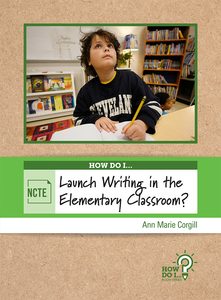
How Do I Launch Writing in the Elementary Classroom?
By Ann Marie Corgill
This text opens with four pages of quotes Corgill shares as the foundation for her responses to the questions of practice that form the chapters of the book. Through artifacts of and for learning, these questions and answers become a guide that can support a novice teacher’s entry into the field as well as a veteran educator seeking to reflect on and refine their current why and how for teaching writing. To aid in learning more about specific topics, Corgill includes titles of other professional texts teachers might select for a targeted learning path.
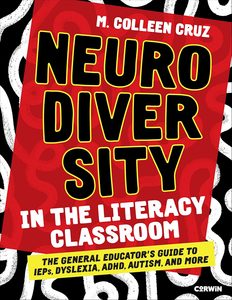
Neurodiversity in the Literacy Classroom: The General Educator’s Guide to IEPs, Dyslexia, ADHD, Autism, and More
By M. Colleen Cruz
Neurodiversity in the Literacy Classroom is filled with the knowledge and resources teachers need to teach writing in ways that are accessible and inclusive. As the subtitle states, Cruz wrote this book for general educators. She crafts a chapter on the Universal Design for Learning framework that not only helps teachers who are not special educators develop or strengthen the ability to detect instructional obstacles but also shows how proactively planning to mitigate them benefits all learners. In this and a later chapter, Cruz provides examples specific to writing instruction and puts forward “scaffolds, tools, and strategies” to increase access and support inclusion.
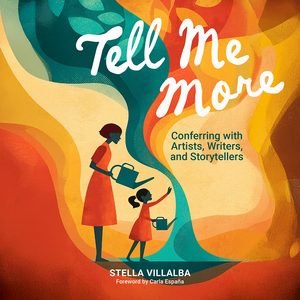
Tell Me More: Conferring with Artists, Writers, and Storytellers
By Stella Villalba
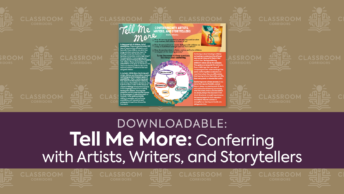
Tell Me More puts forward conferring as a Cycle of Dialogic Encounters that includes five pedagogies: listening, student voice, inquiry, documentation, and collective growth. Part II begins with a bulleted list that explicitly outlines how conferring positions the teacher and the student as contributors to and beneficiaries of the exchange. Through this, the scripts of conferences with student writers, and other examples included in the text, Villalba provides an understanding of culturally and linguistically sustaining practices that teachers of writing can use with learners from the youngest elementary grades.
Trade Books: Featured Title
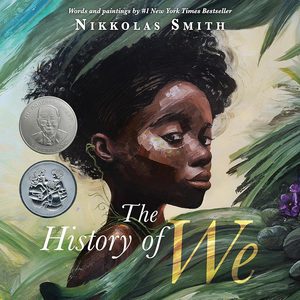
The History of We
By Nikkolas Smith
In this nonfiction book, Smith communicates the origin story for humanity through lyrical verse and acrylic paintings. Each page turn reveals one or more ways We came to be through pictures that subtly propel the reader across time. Thumbnails of the artwork form one of two timelines that provide more details about the history contained. The author’s note makes it clear that this is the story of OUR ancestors. The dedication page, which comes as the last page of the book, provides a final statement by Smith of our common heritage.
Ideas for the Classroom
- In elementary school, learners are still developing an understanding of the ways primary and secondary sources are investigated and used to communicate historical events. They are not aware that choices run throughout this process—choices similar to ones they make when crafting their own personal narratives. They are not aware that their personal stories are a continuation of the collective story of humanity. Using the opening line in the book to begin the collective creation of your classroom community’s own The History of We can develop or strengthen this understanding.
- Ask: What is the origin story for your class? What are the things you do together? Together, recall and chart the things your collective has done since your first meeting day.
- Construct: Create the opening page for this history of your class. Allow students choice in the items from the chart they will write about and whether this writing will be done alone, in pairs, or in other groupings.
- Extend: Allow students who would like to engage in work similar to that done by Nikkolas Smith to research how the school came to be or how their family came to be.
- Deeper Learning: Ask students if they are familiar with another origin story for humanity. Invite them to consider how telling our history from the places on the continent of Africa where the oldest fossils and artifacts have been found changes our story.
- Extend: Invite students to investigate the earliest artifacts they can find of their classroom. Have them compare and contrast artifacts from the most recent week of school to those that can be found from the earliest week. How would the story be different if it started with evidence only from the most recent week?
- Accessible Learning: In addition to the opportunities for engaging through choice described above, allow students multiple ways to demonstrate their understanding. Examples could include using various materials for visual arts to draw, paint, sketch, or form their contribution; creating a timeline for the text; and/or integrating multimedia, such as a soundtrack for the class book, a video recording of a dance or other performance of their portion of the history, or an audio telling of their contribution.
Additional Recommended Titles
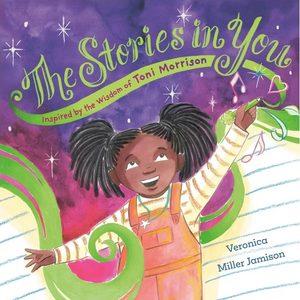
The Stories in You
By Veronica Miller Jamison
When a trip to the library ends without a book, Chloe’s aunt introduces her to artifacts that hold family stories yet to be written. The genius she sees in the clothes, music, and dance inspire Chloe to not only write about these creations but also construct narratives of her own. This book can be used to encourage students to mine their family’s history, develop their voice, express themselves through multiple media, and—like Chloe and her family—advocate for others’ stories to be valued, too.
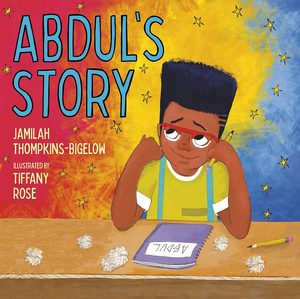
Abdul’s Story
By Jamilah Thompkins-Bigelow, illustrated by Tiffany Rose
Adbul’s Story is about a boy whose ability to tell a story is stronger than his ability to write a story. This book can be used both to encourage students who may be like him and to demonstrate the importance of caring and affirming the strengths of peers for those in the class who are able to write more fluently.
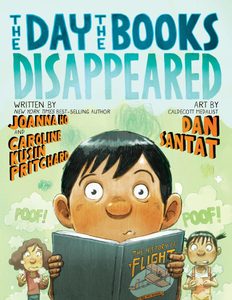
The Day the Books Disappeared
By Joanna Ho and Caroline Kusin Pritchard, illustrated by Dan Santat
Arnold only values books on topics of interest to him and learns the importance of valuing the perspective of others. This book can be used to create an environment in which all stories belong. It can also be used to affirm students in the value added to the collective through their topics and stories.
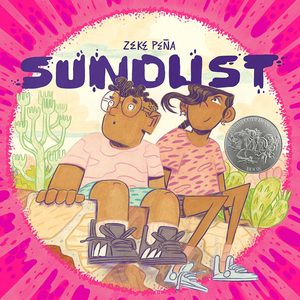
Sundust
By Zeke Peña
Two siblings follow the sundust to explore the beauty and knowledge of the desert. This book can be used to support students in exploring their community from a place of curiosity. It can also help the collective to encourage perspective shifts for authors in need of ideas for other ways to explore place in their personal narratives.
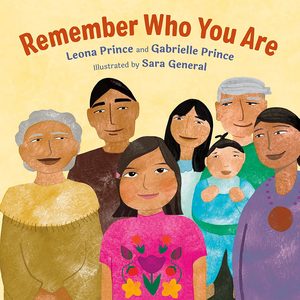
Remember Who You Are
By Leona Prince and Gabrielle Prince, illustrated by Sara General
This empowering story calls on the reader to value themselves not only as descendants of those who came before but also as ancestors of those who will come. The book can be used to support many concepts, including that each individual has a responsibility to—and is needed by—the collective.