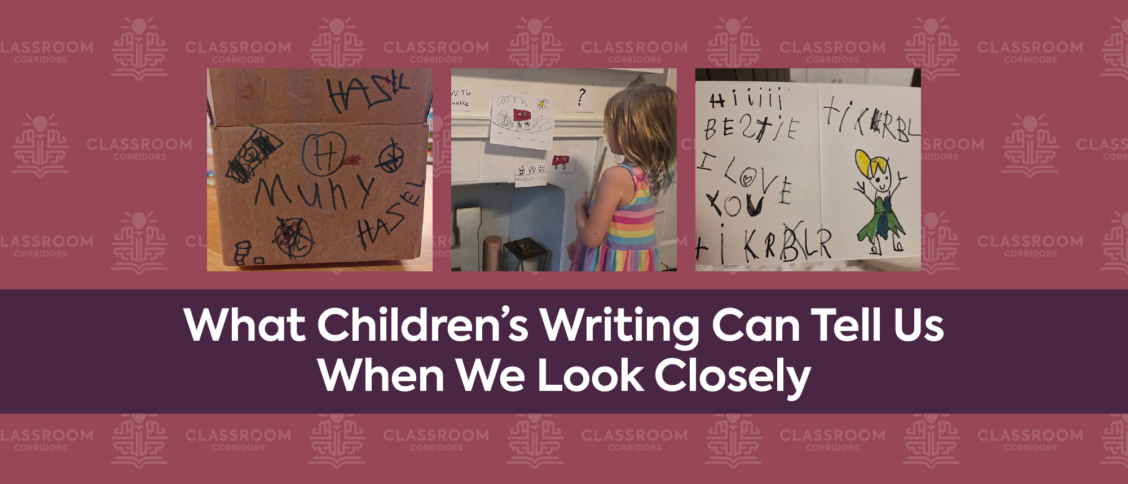

Why did my child spell “jumped” as “jumpt”? At first glance, it is tempting to dismiss this writing as incorrect and move on. But what if that spelling actually tells us something important? Developmental spelling (sometimes called approximated or invented spelling) invites us to look beyond errors and instead ask, what does this child know? What does this child already understand about how words work? When we shift our perspective, spelling becomes less about memorization and more about understanding language. While memorization has its place, decades of literacy research have shown that children do not learn spelling simply by storing lists of words. Instead, they develop increasingly sophisticated understandings of how sounds, letters, patterns, meanings, and words work together.
Children’s spellings, even unconventional ones, reflect their current understanding of English orthography. For example, a child who writes “sed” for “said” has demonstrated strong sound-symbol knowledge, even though the conventional spelling is different. Another child who writes “jumpt” for “jumped” understands that the final sound is /t/ but has not yet learned how the past-tense morpheme is represented in print. These approximations show learning, not simply mistakes.
What Is Developmental Spelling?
Developmental spelling is based on the idea that students progress through predictable stages as they learn how English spelling works. Rather than expecting every child to master the same spelling features at the same time, teachers can analyze students’ spellings to determine what concepts they understand and what they are ready to learn next. Developmental spelling gives teachers formative assessment information that standardized spelling tests rarely provide. Teachers can look for secure patterns and note what errors reveal about students’ phonetical knowledge.
As a previous teacher and clinician, and current researcher and parent of a six-year-old rising first grader, I was interested in investigating my daughter Hazel’s writing during summer break. During her kindergarten year, Hazel was enrolled in a Spanish immersion classroom where 90 percent of instruction was in Spanish. She made significant gains in both English and Spanish letter knowledge, letter sounds, and early writing. Even as a prereader, Hazel enjoyed stories, writing, and illustrating her own books. At the end of kindergarten, Hazel had a strong knowledge of consonant and short vowel sounds but was hesitant to write independently. Instead, she would repeatedly ask me how to spell various words or to give her a model of what she wanted to write so she could copy it.
Investigating Summer Writing
At the start of summer, I encouraged Hazel to write more and to write words based on the sounds she heard, without worrying about whether each word was spelled perfectly. Below I will share a few examples of her growth in developmental spelling over approximately six weeks. As teachers, looking closely at a child’s writing over time can help inform future instruction.
Example 1: Money
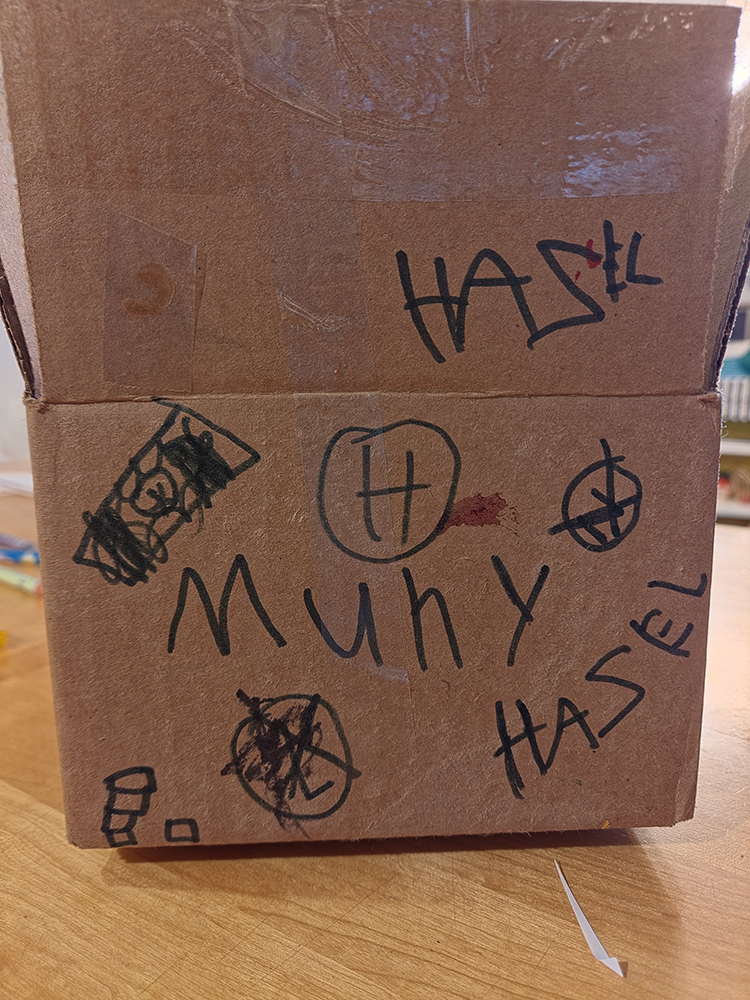
Hazel was excited to get money from the tooth fairy and wanted to make her own bank out of a cardboard box. In this example, Hazel has a secure understanding of the consonant sounds /m/ and /n/. She heard the schwa sound for the first vowel sound and represented it with a short vowel u. She did use a y to represent the ending sound of /ē/ on her own. We have had several conversations about ending /ē/ sounds being represented by a y.
Example 2: One of the unicorns
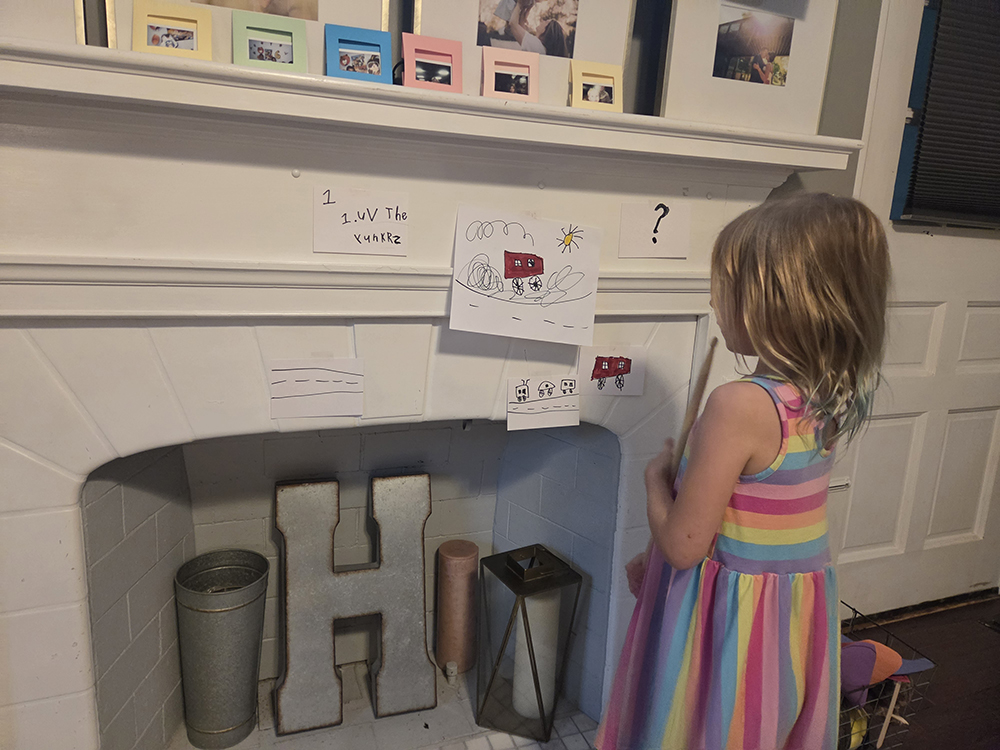
Hazel was creating a scavenger hunt for her sister, and one of the clues was “one of the unicorns.” She represented “one” with the numeral one. She spelled “of” as “uv.” For this spelling, Hazel again represents the schwa sound with a short vowel u. She then hears the soft /v/ sound at the end and represents it with the letter v, instead of the conventional spelling using the letter f. She spells “the” correctly, since that is the most common sight word she has learned. She spells unicorns as “yunkrz”. She’s hearing the soft /y/ sound at the beginning of unicorn. She also hears the consonants /n/ and /k/. She can hear the r-controlled vowel sound, and she represents that by the letter r. The ending /s/ sound carries some vibration, making it sound like /z/. Hazel hears that sound and represents it in her word as the letter z.
Example 3: Hiiiii Bestie I love you Tinkerbell
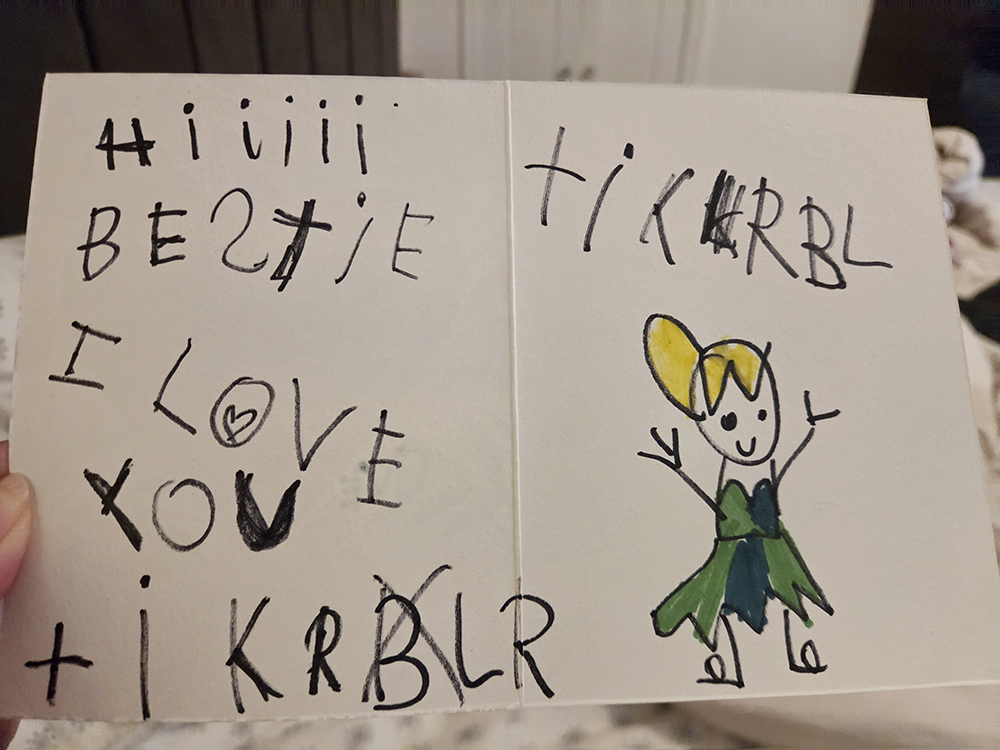
In this example, Hazel writes “I love you” correctly, since this is a phrase that she writes frequently. When writing “Tinkerbell,” she hears the initial consonant /t/ and correctly includes the letter i as the first vowel sound. She represents the /nk/ sound with the letter k. Again, she hears the r-controlled vowel and represents it with the letter r. For the “bell” segment, she hears the consonant sounds of /b/ and /l/.
Example 4: Hi Cowgirl how is it[?]
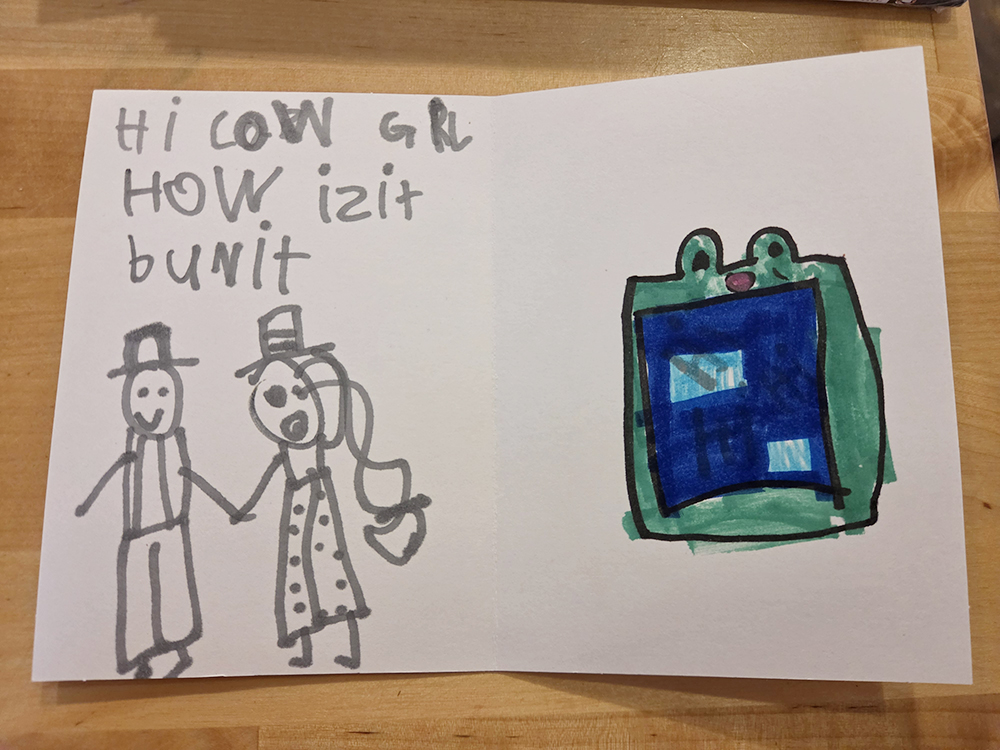
Hazel was excited to see the new Toy Story movie and drew scenes from the movie. In this example, Hazel spells “girl” as “grl,” hearing the initial sound and ending sound, but continuing to represent the r-controlled vowels with just the letter r.
Example 5: When you are done with school, you might [wit] to the [bes] [eben] you will jump into the pool
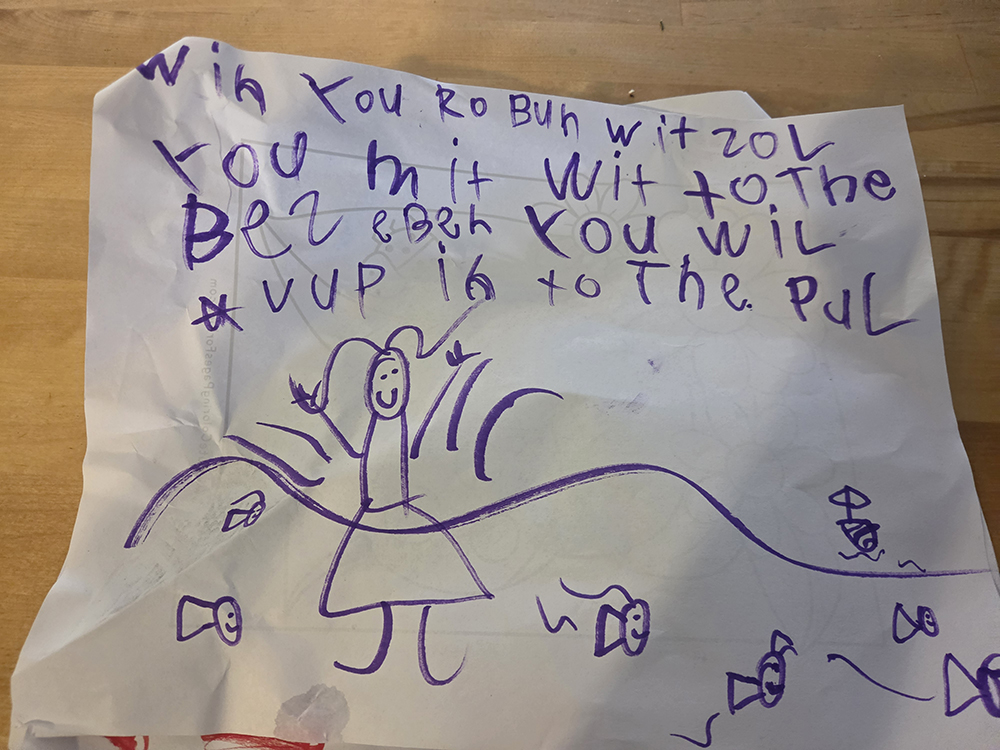
In this example, Hazel consistently hears the first and last consonant sounds in words. She consistently spells the sight words “you,” “to,” “the,” and “in” conventionally. She often flips or swaps the letters b and d in words, such as in writing a b as the first letter in the word “done.” She is still working on complex vowel patterns, like the double o in “school” and “pool”, which she represented in her writing as the letter o and letter u.
Example 6: Lucie I hope that you have a great birthday
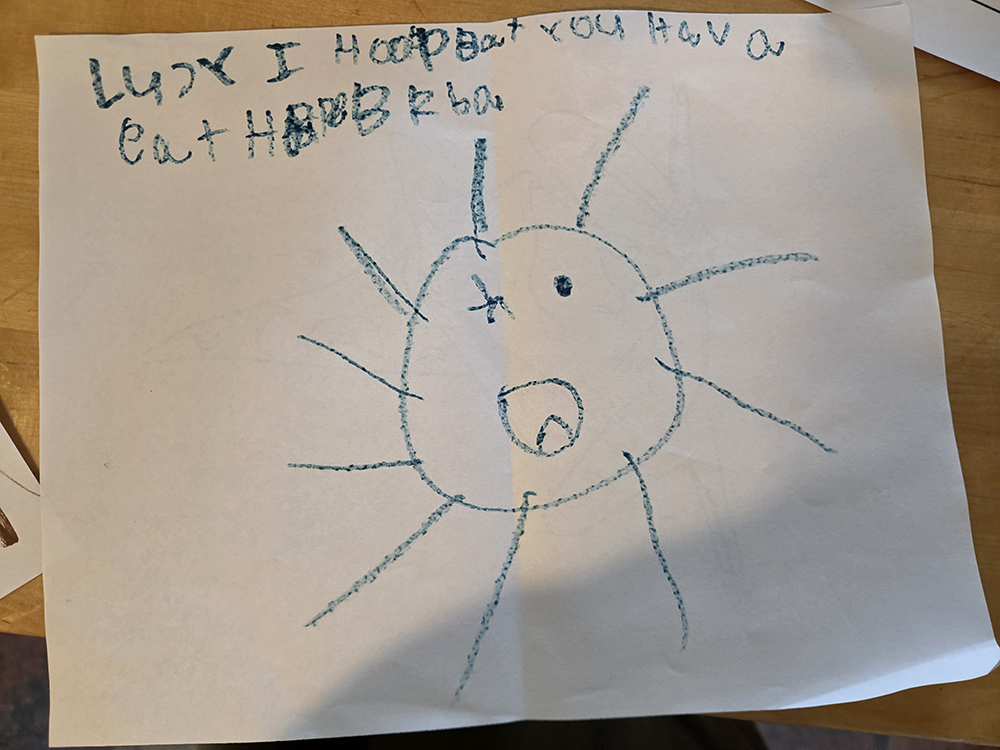
Hazel wanted to write her sister, Lucie, a birthday card. In this example, Hazel is also swapping the letter b for the letter d. She is also confusing the letter d for the /th/ sound, since they sound similar when voiced. She spells birthday as “br(d)a.” She hears the initial consonant, then the r-controlled vowel, the mid consonant d, and then the long a sound. However, she skips the voiceless /th/ sound.
Example 7: The Capybara Book
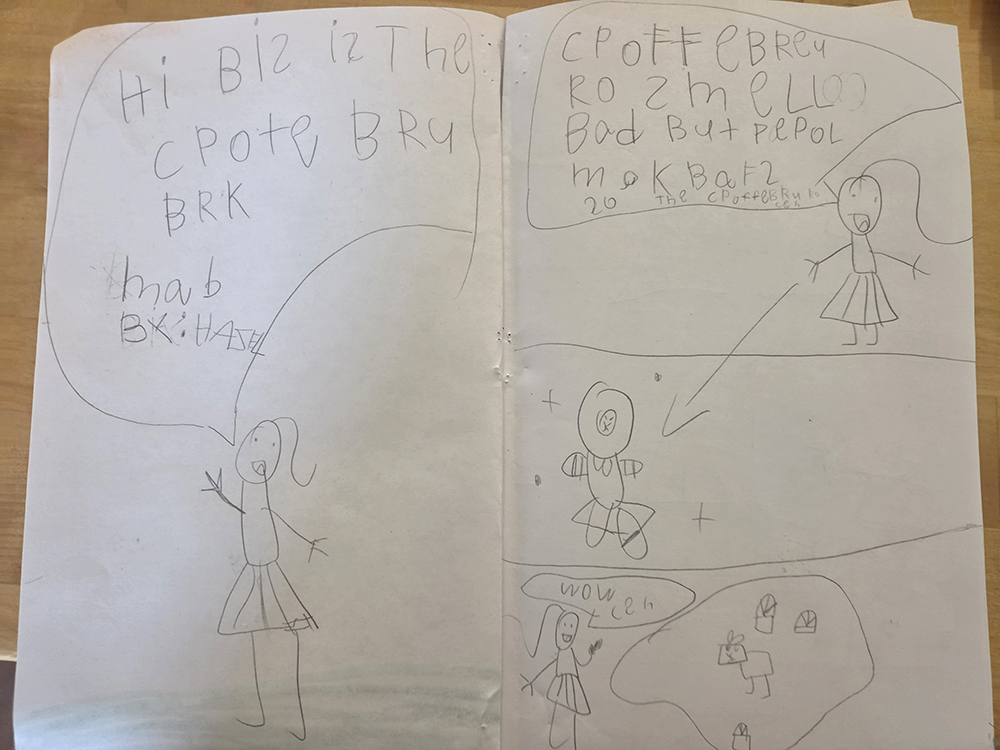
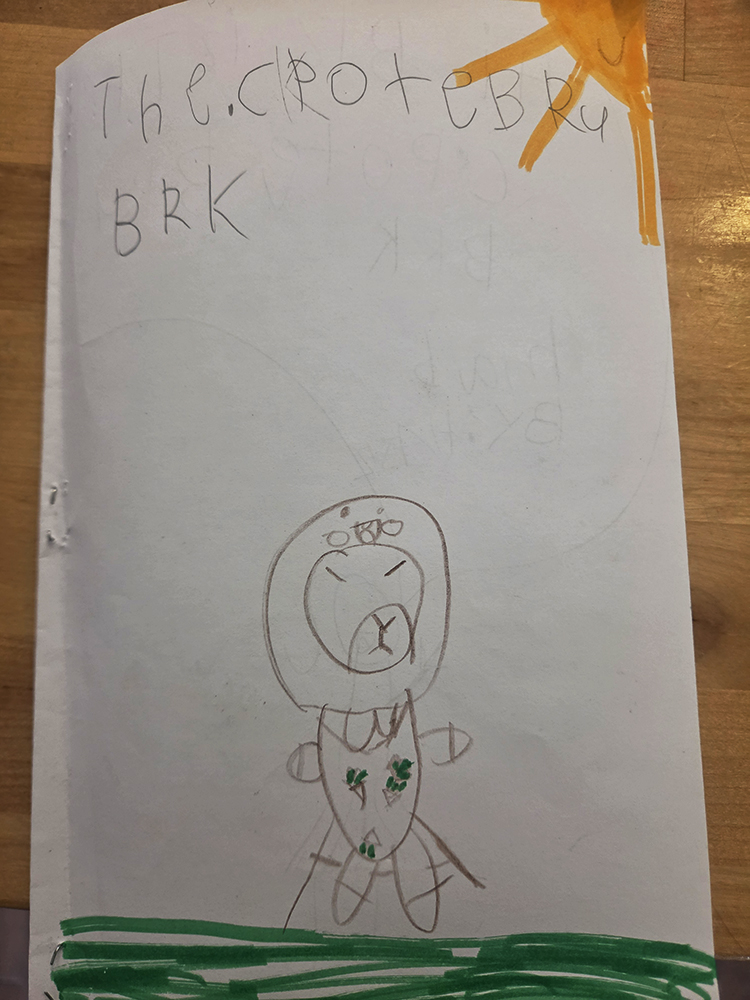
Hi this is the capybara book made by: Hazel
Capybaras(?) smell bad but people make baths for(?) the capybaras
Wow clean
In this example, Hazel was starting to write a book on capybaras. It is interesting to note that Hazel spelled “capybara” differently throughout her text (e.g., cpotebru, cpotebreu). She can hear the initial sound, middle consonants (/p/, /b/), and the r-controlled vowel. She is representing the schwa at the end of the word with the short vowel u. She tends to reverse the letter s in her writing. For the word people, she heard the initial and middle consonant sounds and represented the /ē/ sound with the letter e. For the ending, the letters at the end of the word people sound like “puhl,” and she represented that with “ol.”
Developmental Spelling Summary
Hazel has several secure patterns including initial, middle, and final consonant sounds, short vowels, and several sight words. Her areas for growth and areas for future instruction are r-controlled vowels, complex vowel patterns, and patterns that use the schwa. Also, when comparing her writing across the six weeks, the amount and complexity of her writing increased significantly. For Hazel’s continued growth, it will be important to foster a love of writing and stories. Hazel’s complexity improved over the summer as she had meaningful, engaging real-world things to write about. Hazel had an audience and could choose what she wrote. Supporting this type of writing, along with her developmental spelling, will be important to her continued growth.
Conclusion: Shifting Our Mindset
One of the most powerful changes developmental spelling brings is a shift in teacher thinking. Instead of viewing spelling errors as evidence of failure, we begin seeing them as evidence of growth. Every approximation represents a hypothesis about how English works. When we observe children’s spellings, we gain insight into their thinking, and that insight allows us to provide instruction that meets students exactly where they are. Developmental spelling reminds us that learning to spell is not only about memorizing words. It is about discovering the patterns within the English language, one story at a time.