
August 10, 2026
Dear Fellow Educators and Storytellers,
I sit here at my kitchen table, the bright summer sun filtering through my window, a stack of books next to my computer. As I sit here to write this letter to you, I picture you receiving it in October, and I smile as I think of the many stories that are swirling around your classroom.
I imagine your young writers filling notebooks with the stories of their heart. Their stories take shape in the sketches, the scribbles, the strings of letters, the sentences, the paragraphs that your young writers put to the page. Their stories tell of moments and memories and ideas that demand to be put to paper, documented, and shared with you, their fellow writers, and the world, so that they are never forgotten.
Though many, many stories have been shared, written, and made public, there are still some stories that have yet to be verbalized or make it to the page. As educators, we have the greatest honor and privilege to sit in community with our young writers and bear witness to their words, ideas, and perspectives as they write, revise, and write again. With every piece they compose, they rise.
As I write, I find myself reflecting on the many writing communities I have learned with over the years. I think about the young writers, adolescent writers, and adults whom I have had the great honor of writing and creating alongside. One community that reminds me of this truth is Somos Escritoras, a writing and art community I founded for Latina girls (grades 6–8), and the many, many cuentos we have shared in this space. At the heart of Somos Escritoras is the belief that our girls are writers, storytellers, and artists, and that they have important stories and ideas living inside of them.
For the past 10 years, we have gathered en comunidad for one week to unearth our stories, document our histories, and speak our truths through art, writing, and storytelling. And, every single year, my escritoras compose stories rooted in their identities, their rich cultural and familial histories, diverse linguistic practices, and their hopes and dreams, as well as those of their families and communities.
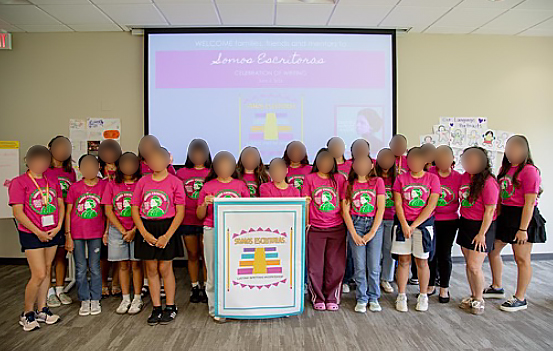
In my work alongside my escritoras, I am reminded that our writers have important ideas, perspectives, and stories to share with the world. And, though I hold this belief and carry it into my work with my escritoras and in other writing communities, not every writer comes into our classrooms believing that they are writers or that their stories matter. Many times, society sends messages that who they are, where they come from, the languages they speak, and their stories do not matter. Sometimes these messages are internalized, and to protect themselves, our writers choose to move more quietly through the world, withholding their ideas, muting their voices, and silencing the songs of their hearts. And yet, even in their silence, their stories remain. Their stories continue to beat and live inside them, waiting for a call, an invitation to be released.
Our classrooms can become that call, that invitation, where our writers discover the power of their voices and stories to change their world. We can invite our writers to compose for many purposes and for many audiences, giving them time and space daily to practice, tinker, play, and take risks in writing. We can introduce our writers to the work of artists, storytellers, poets, and writers who have used their art and writing to ask questions, explore their lives, raise consciousness, examine the world, and heal.
And this begins with teaching the writer.
We can create a writing curriculum that is rooted in the lives of our writers, inviting them to compose across languages and draw on their cultures, identities, and experiences as resources in their writing. We model for them in our words, actions, and curriculum that we believe they are writers, and that their stories matter.
Today and every day, we must continue cultivating spaces with and for our writers that invite them to share their stories, discover the power of their voices, honor their lived experiences, and step into their power as writers, storytellers, and creators. Thank you for all you do every single day. I celebrate you and your brilliant storytellers, writers, and creators. ¡Adelante!
With love and in solidarity,
Tracey Flores
Suggested Resources
Anzaldúa, G. (2015). Speaking in tongues: A letter to Third World women writers. In C. Moraga & G. Anzaldúa (Eds.), This bridge called my back: Writings by radical women of color (4th ed., pp. 163–172). State University of New York Press.
Baca, J. S. (2001). A place to stand: The making of a poet. Grove Press.
Flores, T. T. (2023). “We are more than that!”: Latina girls writing themselves from margins to center. Research in the Teaching of English, 57(4), 332–354.
Flores, T. T., & Fránquiz, M. E. (2023). Cultivating young multilingual writers: Nurturing voices and stories in and beyond the classroom walls. National Council of Teachers of English.
Graves, D. H. (1983), Writing: Teachers and children at work. Heinemann.
hooks, b. (2014). Sisters of the yam: Black women and self-recovery (2nd ed.). Routledge.
Mora, P. (1990). A letter to Gabriela, A young writer. English Journal, 79(5), 40–42.
Muhammad, G. E. (2012). Creating spaces for Black adolescent girls to “write it out!”. Journal of Adolescent & Adult Literacy, 56(3), 203–211.
Peterson, R. (1992). Life in a crowded place: Making a learning community. Heinemann.