
If you’re imagining the most robust and energized elementary classroom, you likely envision children in heated conversations, lots of learning mess, and richly decorated walls. You might imagine lots of color; you might visualize books, enticing charts, and evidence that children are growing and learning here.
Close your eyes and think about families with children, too. Often, there will be lots of parallels: tons of conversation, artwork and different media strewn all over, and texts of all shapes and sizes that include story, history, and information.
I am a longtime classroom educator and literacy coach, and I now facilitate family literacy engagement in schools across the country. As a mother of four young children between second and 10th grade, I know that this work is heart-work, full of honest conversation, emotion, and nostalgia. Collaborating with families isn’t a checkbox thing, nor is it a one-and-done situation. Rather, it is an ongoing endeavor to grow experiences that naturally include families in unbiased, loving ways.
To do this well, we must believe that:
- Teaching and caregiving are reciprocal acts, and families are teaching their children rich literacy experiences every day.
- Education does not happen solely in school.
- Expansive definitions of “literacy” and “reading” must exist inside and outside classroom walls in order to validate what all families already contribute.
Invitations for Families: Shared Classroom Experiences
One way to underscore these tenets is to facilitate shared experiences with families in the classroom that easily incorporate conversation, critical thinking, and art creation. Classroom educators who are busy and don’t have time for one more thing need not look further than simple invitations for caregivers to join in family “labsites,” which are shared literacy experiences with their children, preferably in the classroom space. Labsites feature a literacy strategy that students use in class and families can extend outside of class.
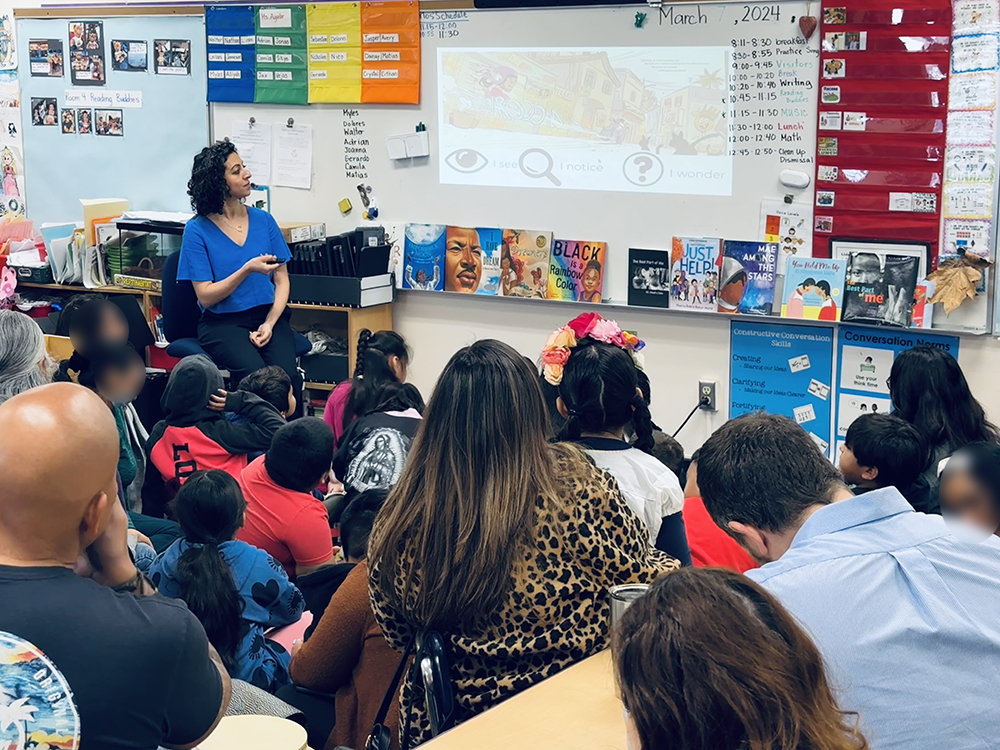
When I conduct family labsites in schools, I model a three-part lesson that includes a short direct instructional component and model of a reading, writing, or thinking strategy. Then, caregivers are sent off to work in partnership with their children to practice the strategy. Last, I name plainly for families how they can continue this work at home and off campus to continue supporting their children.
Below is an example of a text and family literacy labsite plan that works beautifully in elementary classrooms, using author and illustrator Katie Yamasaki’s books, particularly her upcoming title: Invisible Crown (2027). In it, a young girl wears a “crown” of everything that’s in her head and heart, including her joys, worries, and pains. Throughout the story, the little girl notices her friends and mother also wearing similar crowns, with their own personal passions and histories.
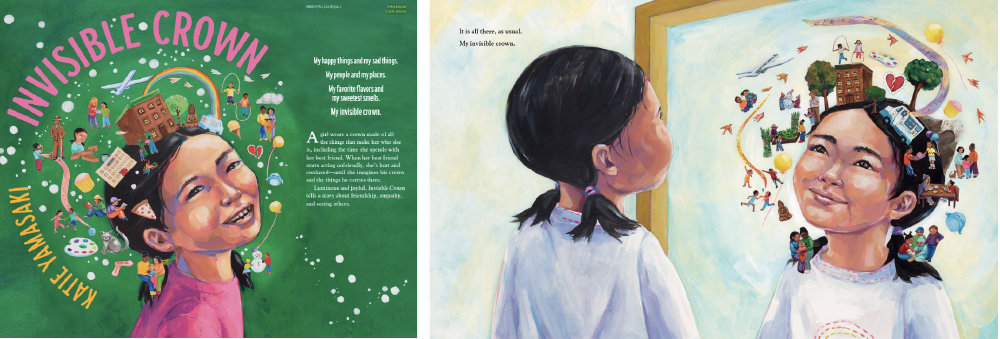
In a family labsite in a New York City school at the start of this year, children and their caregivers gather on the rug to observe me modeling my own invisible crown drawing. They watch as I depict my children; my pup maltipoo, Evie; my block. I add war overseas; I add a broken heart for my uncle Hamid, whom I miss dearly. I add music and explain that I grew up listening to classical Persian piano; I add ballet shoes for my daughter Ezzy, who is becoming a ballerina. All of these things I carry with me throughout the day.
“Now I want you to think. What two or three joyful things do you carry in your invisible crowns?” I ask the group. I prompt them to turn and talk with one another and lean in excitedly to listen.
One girl tells her mother she loves mint chocolate chip ice cream. A boy tells his sister that he carries Pokemon cards with him in his mind. Another girl says she thinks about traveling to Puerto Rico to see Abuela. I hear a mother tell her child, “I love roses,” while another says, “being done with work for the day.” We make eye contact then, and laugh.
I commend the classroom for their widely varied joyful things; I theatrically wave my arms around and grin at the crowd. “I love all of these things you’re carrying around on your invisible crowns. Ladybugs! Scooting to the park! Friday family movies!”
I bring the attention back to me at the front of the room and ask that the group now think about more painful things. “We all carry sadnesses and hurt or worry in our hearts, too. Those are things that show up in our invisible crowns. For example, I worry about my daughter in high school, and whether or not she will make the right choices.” I draw a stick figure of Eliana as I speak. “I worry about the unhoused people who live in my neighborhood, who don’t have shelter from the pouring rain.” I draw rain coming sideways across my crown. “What do you all worry about?”
As I listen solemnly to the conversations that children are having with their parents and siblings in both English and Spanish, I realize how much I’m learning about these students and what’s important to them—thus helping me better teach them throughout the year.
Independent Work Time
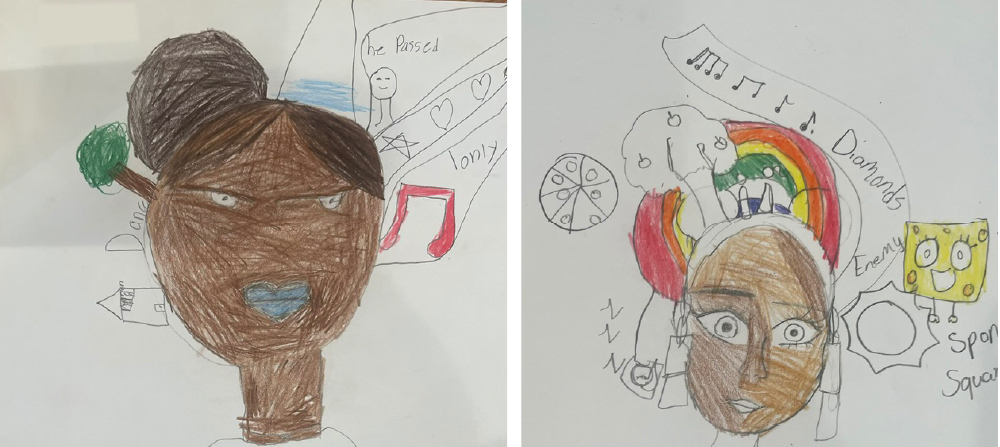
During the independent work time, I display pages from Yamasaki’s book with example crowns on it while walking around to listen to families talk with their kids as they all draw. I encourage shared pens and big paper—sometimes drawing on big butcher paper so that everyone’s invisible crowns are connected and visible, thus elevating more of a collectivist mentality for our shared experiences.
This is not a time to correct or name rights and wrongs, but instead to validate all that children and families are experiencing. You might keep a mental list of what you notice:
- What languages are families speaking?
- What sorts of body language do you notice, thus telling you more about the child’s relationship with the caregiver?
- What questions do families have for you while they work alongside their children? What do you learn about them in the silences?
- How can this shared literacy experience springboard more conversation between children and their caregivers?
Labsite Debrief
At the end of the short session, I ask that table groups share one or two things on their invisible crowns. I show families a slide on screen with the writing process and share with them that what they just engaged in with their children is an example of brainstorming—because now, these early drawings can be fodder for personal narratives and stories. I encourage families to talk about their emotions, joys, and worries with their children, sharing that the more they converse in any language, the more helpful it is to build vocabulary.
I end with reading the entire book aloud and recommending more of Yamasaki’s works and murals across the city. I always recommend local authors and share examples of where families can find more of their work to ensure that children see themselves in the stories we read in community.
Final Recommendations
To this end, authentic family literacy engagement means debunking a simple and straightforward definition that is solely measured by attendance at back-to-school nights or potlucks. Instead, authentic family literacy engagement provides space for collaborative, two-way experiences, where all families feel better equipped to support their children, ask questions, and share their passions. Action research across the country shows quite plainly that one-off literacy nights and family-facing workshops do not work or move the needle in terms of truly creating trusting partnerships with a sense of belonging. Instead, schools and districts need:
- A reframing of definitions of family engagement, including professional learning and reflection time for all staff around biases we naturally carry
- Protected time to learn about family labsites and invitations for shared classroom experiences
- Planning time to incorporate family literacy experiences into already existing curricula and school calendars
Throughout the year, I encourage four to six family literacy labsites that directly correlate to classroom learning and practice. Families already grow their children’s literacy lives richly every day—we just need to name it for them. Real family engagement cannot be captured in a single evening or measured by attendance at a potluck. It is an ongoing, reciprocal act of care—a quiet trust built over time. When we make space for family labsites within our everyday walls, we honor the rich tapestry of language and experience every child carries across our thresholds.
By protecting time for staff to reflect, unlearn bias, and invite caregivers directly into the learning journey, we shift our schools from places of instruction to communities of deep belonging. We do not need to give families a voice—we need only to listen, name the magic already there, and welcome them home.