
Dear teachers,
I’ve been thinking about you. A lot. The demands of the school year are in full swing, and one of the busiest times of the year is fast approaching. There are so many directions in which you’re being pulled, and a work-life balance may seem like an unattainable aspiration. I have felt that, too.
At this time of year, I remind myself to be present, be grateful, and enjoy the moments happening around me. Simultaneously, I feel a bit guilty for always looking ahead to the ambitious goals I still want to accomplish. The dichotomy of that sometimes feels paralyzing. If I focus on the things I still want to achieve in the future, then how can I truly be present? It is easy to feel like being highly motivated is synonymous with not being grateful for my current circumstances.
Another time of year when I always feel this is at the end of the school year. I cling to my last few days with those tremendous little humans in the special classroom family we’ve built, while simultaneously thinking ahead to what I want to accomplish with next year’s class. I ponder what I need to research and prepare over the summer, and what I need to modify or improve so that my future students can be successful, too. It can honestly feel like I am standing on a border with each of my feet in a different state, so I try to identify small action steps that I can take to relieve this feeling of angst. I look for those mindful practices that help me to feel more grounded.
Mindfulness can be defined as “the state of being conscious or aware, achieved by focusing one’s awareness on the present moment.” It also entails being open to new experiences. Before I leave on Fridays, there are certain tasks I complete for the following week. One is to leave an individual note for each of my students on a dry erase square adhered to their desk. While I also do this on other days, when they walk in on Monday morning, I want them to see a new message waiting for them, as part of a positive start to their week. I want to fill their hearts and heads with the possibilities for not only what they have accomplished, but what they can accomplish. In November 2023, The National Institute of Health published a study by Xue Wang about the correlation between teacher mindfulness and the quality of teacher-student relationships. Not surprisingly, Wang found a direct association. I can certainly see the outcome of this, as I watch students race to their desks to read their notes and see their faces light up when they see messages like “A reading rockstar sits here!” or “I can’t wait to read your next story!” or “You are our sunshine on cloudy days!”
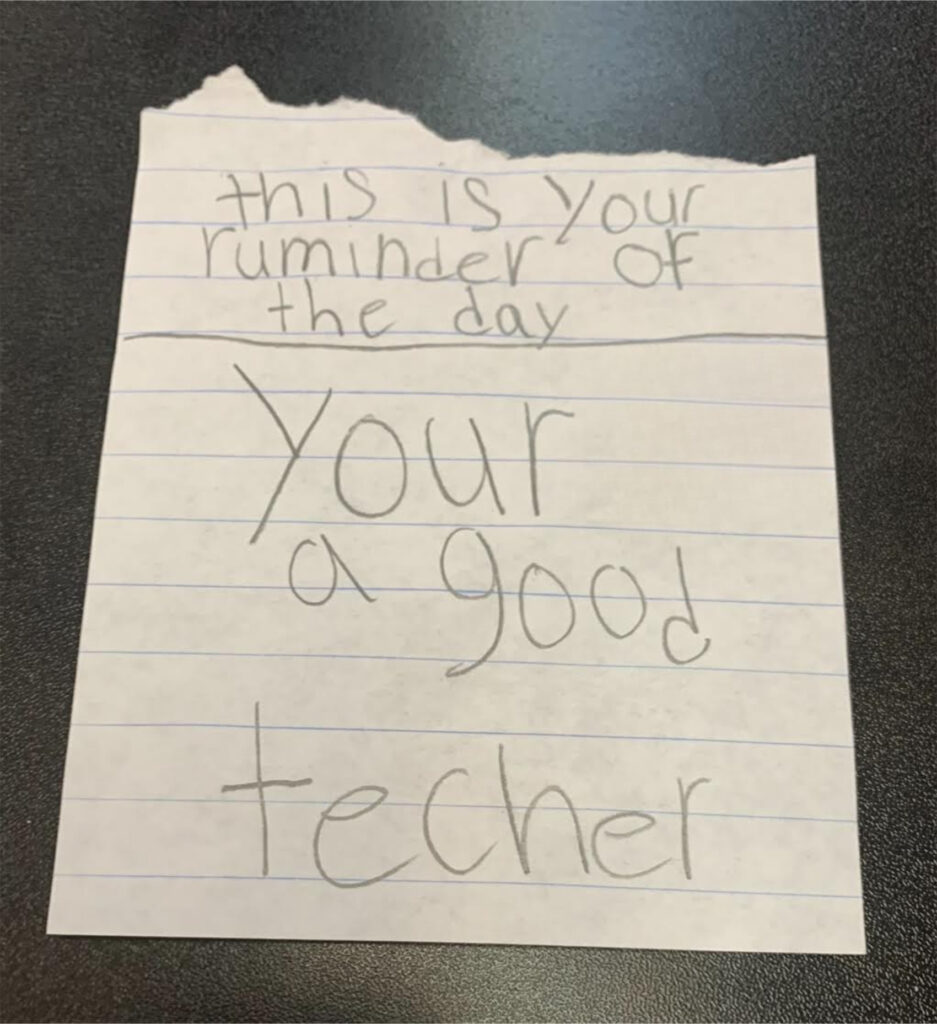
Early last year, I had returned from an IEP meeting that had run long and found a small piece of paper torn from a notepad on my desk. In beginner third-grade handwriting, the message on it said, “this is your ruminder of the day—your a good techer. Love, _____.” This small gesture made me feel validated, seen, and capable of persisting through challenges—the very response I had hoped to kindle in my students.
Last week, as I wrote out the latest Monday messages for my students, my mind returned to that moment, and I realized that gratitude and ambition are not mutually exclusive. Having an audacious vision, looking to the future, and striving to make things better for ourselves and, by extension, our students, does not mean we are not grateful for what we have now. In fact, by doing so, we are demonstrating the courageous dreams we hope our students will dare to envision. Your dreams are proof of your desire to grow and evolve, and your current good fortune is the result of your previous aspirations. Your students see this in you. This is YOUR reminder that you’re a good teacher. Keep dreaming boldly. Your students are grateful that you do.
Thinking of you,
Jenn
References
Wang X. (2023, November 29). Exploring positive teacher-student relationships: The synergy of teacher mindfulness and emotional intelligence. Frontiers in Psychology, 14. https://doi.org/10.3389/fpsyg.2023.1301786