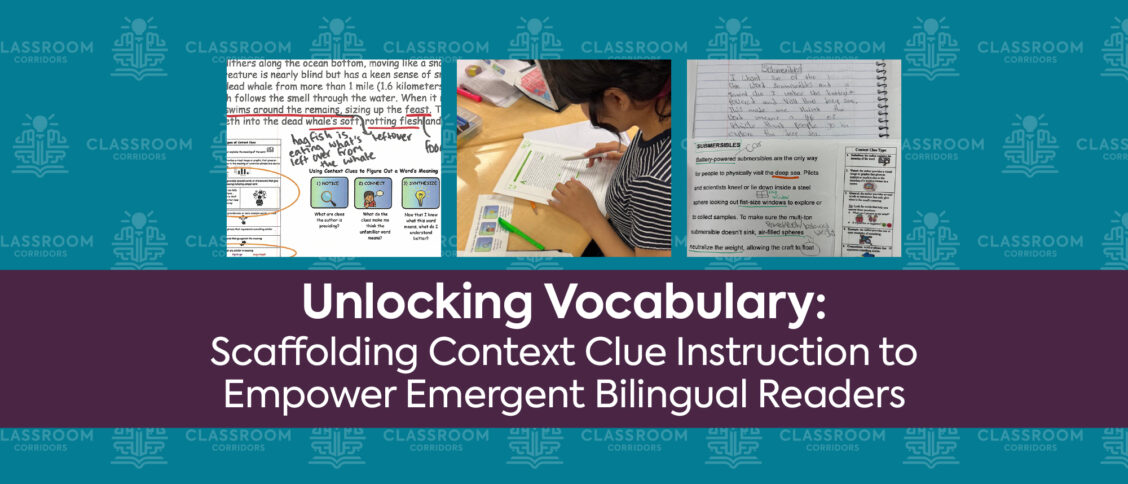

This article centers literacy instruction for emergent bilingual readers as teacher-writers share the stories of their classrooms and their interactions with students, providing examples of effective and supportive instruction of strategies and content for all readers.
Reading informational sources can be a joy for emergent bilinguals, expanding or changing their understanding of the world and strengthening their acquisition of the English language. These texts frequently include a wide variety of unfamiliar vocabulary words for readers, requiring multiple strategies for figuring out the meaning of these words. Instruction in word-learning strategies should be multifaceted (International Literacy Association, 2017). In our classrooms, we teach students key vocabulary words, we teach morphology, and we teach students how to recognize cognates—all of which help students use “within word” learning strategies. We also teach students how to “look around the word” for context clues (Cunningham et al., 2024). This can be difficult, as authors employ several types of clues. In this article, we describe high-leverage scaffolds we have found useful for supporting multilingual learners learning to identify and make sense of context clues. These include explicitly teaching the types of context clues, modeling for students how to identify these clues, and providing language-rich opportunities for them to collaborate and problem-solve.
Frequently, these texts have words that are unfamiliar to readers. Using context clues as a resource for figuring out the meaning of those words can be critical to comprehending bigger ideas in a text. This is especially the case for the emergent bilinguals in the school we work in.
Explicitly Introduce the Types of Context Clues
Our ultimate goal is for students to identify context clues with automaticity, which means they don’t necessarily have to identify the “type” of clue. However, up front, introducing and naming specific types of clues help the students know what to look for. This has become an important part of our practice.
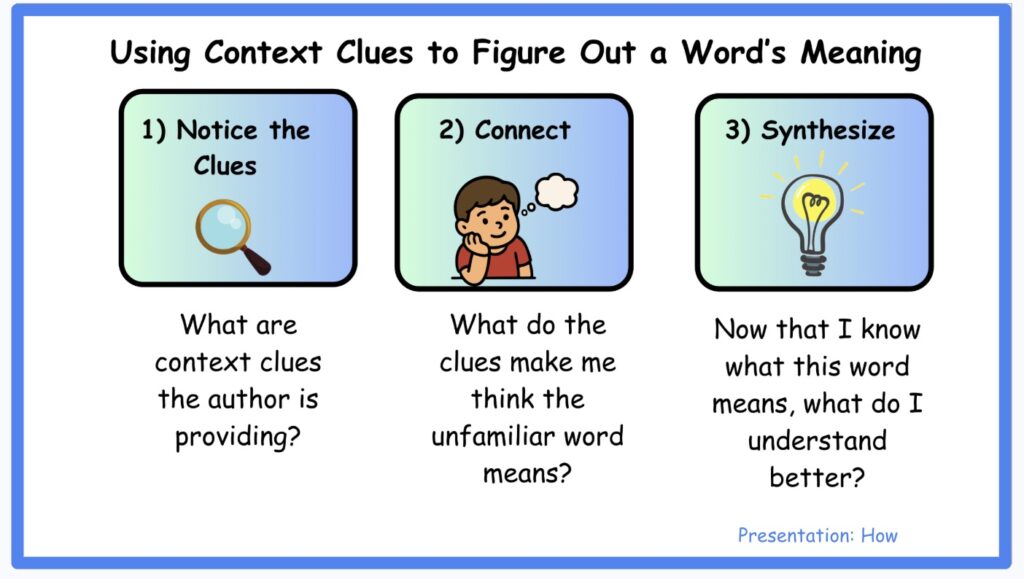
We began the lessons by talking about what readers know to be true: that as readers we will come across words in texts that we do not know, and while some words may be skipped without impacting meaning, many are critical to key ideas in the text. Then we discussed why it’s important to stop and make sense of key words: we will understand the text better and, as a result, we will be more likely to remember what we read (Perfetti & Stafura, 2014). Next, we projected the anchor chart below with three steps for how to strategically process context clues: (1) Notice, (2) Connect, and (3) Synthesize. The chart includes visual images and key questions to support emergent bilinguals (Honigsfeld, 2019).
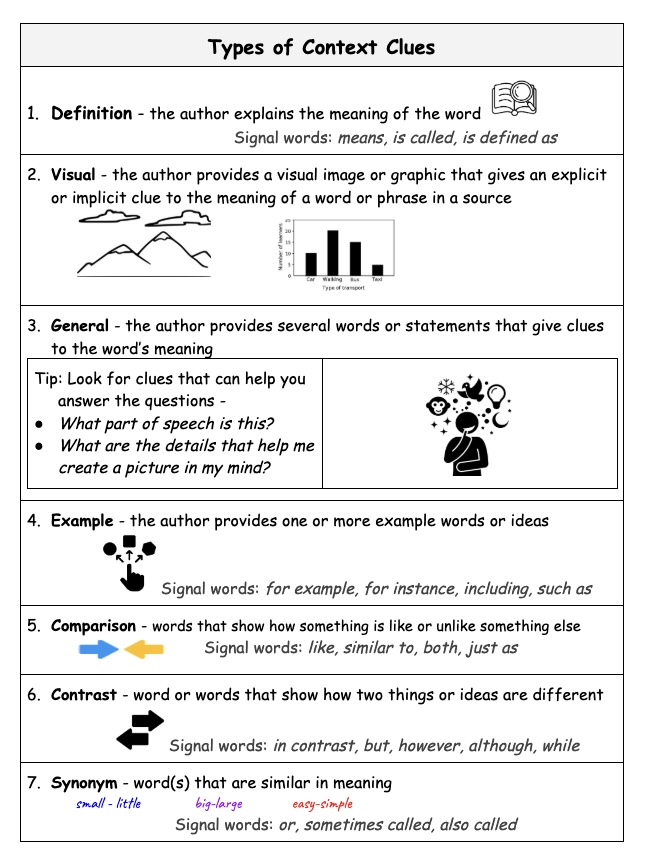
We followed by explicitly introducing seven types of context clues to the students. Below is a handout similar to the one we shared with the students (Cummins, 2019). This took place over the course of several lessons and multiple units with a focus on one to two types of clues at a time.
Model for Students and Gradually Release Responsibility
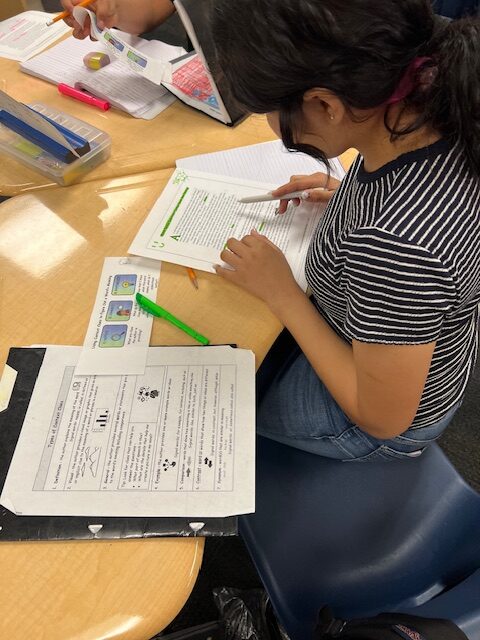
The excerpts from informational sources are chosen from mentor texts being used in the larger reading or writing unit of study or they are related to content area instruction. For example, in one unit of study, an excerpt was chosen from When Lunch Fights Back: Wickedly Clever Animal Defenses (Johnson, 2015); during another series of lessons, Gissela and Guadalupe chose texts aligned with the topics for American history they were studying at that point in the year. Generally, students have a chance to read the whole text before a lesson is done with an excerpt from the text. For each lesson we project the anchor chart, the handout with the clues, and an excerpt from a text to be used during a demonstration or guided practice. During guided practice students also have a copy of the projected text.
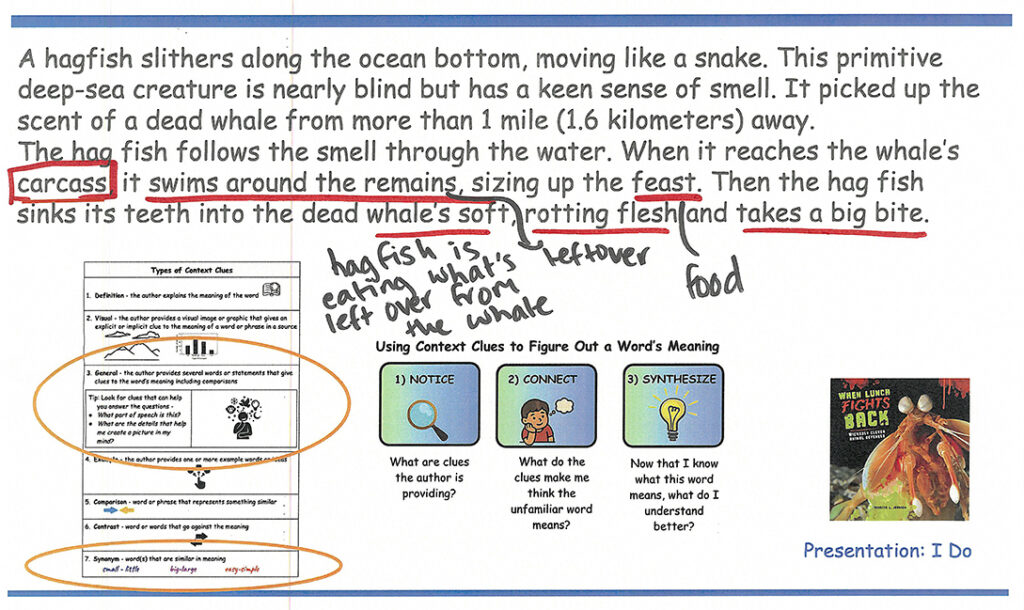
Early on, Gissela gave a lesson in which she demonstrated making sense of the word carcass in an excerpt from When Lunch Fights Back: Wickedly Clever Animal Defenses (Johnson, 2015):
The hag fish follows the smell through the water. When it reaches the whale’s carcass, it swims around the remains, sizing up the feast. Then the hag fish sinks its teeth into the dead whale’s soft, rotting flesh and takes a big bite (p.6).
With the text, list of clues, and anchor chart projected, Gissela thought aloud about how she made sense of the word carcass by saying the following:
As I was reading this page, I came across some unknown words. Have you read a word and thought, “What does that mean?” [Class responded.]
I’m going to draw a box around “carcass.” I see the word “whale’s” before it, so I think it has something to do with a whale. But I don’t know for sure, so I’m going to read around the word and look for clues. [Pointed to Step 1: Notice on the anchor chart.]
So, thinking about my context clues, I know I’m going to underline “swimming around the remains.” I’m also going to underline “feast.” I know that feast refers to food, and I’m connecting. [Pointed to Step 2: Connect on the anchor chart]. I know when I eat a big meal, there are some remains left over, or if I’m eating wings, I know that there are remains of the bones, so I know remains means leftovers. [Gissela wrote “leftover” on projected text and then referred to the handout that lists the types of context clues.] I’m thinking “remains” might be a synonym for carcass. I’m not sure if that’s the correct meaning, so I’m going to read the next sentence.
Gissela continued to think aloud about general clues in the last sentence, underlining “soft rotting flesh” and jotting her thinking. She referred to Step 3: Synthesize on the anchor chart and summed up what she learned about not only the meaning of the word carcass but also how a hag fish eats from the whale’s carcass or remains. Below is an image of her annotated text. This think-aloud included several important scaffolds for emergent bilinguals: projected text and anchor charts for students to view, Gissela annotating the text in front of students, and thinking aloud about how she made sense of the word carcass (Honigsfeld, 2019; Moses, 2024).
Gissela closed by pointing to a posted sentence frame: I wasn’t sure about the meaning of ______, so ______. Frames like this provide clear examples for emergent bilinguals of language they can use to explain their thinking (Kinsella, 2015; Fisher et al., 2025). Gissela used this frame to help wrap up her think-aloud:
I wasn’t sure about the meaning of carcass, so I noticed that there were some helping clues. I found that there was a synonym for carcass, which was “remains,” and it made me think about how remains are what’s left over. And then there were general clues like “soft rotting flesh” that helped me realize that the whale’s carcass is the remains of the whale’s body. Now take a moment and talk with a partner about what I did to make sense of this word.
After modeling for students, Gissela and Guadalupe spent several lessons using a similar routine, guiding (WE DO) and facilitating collaborative conversations (YOU DO TOGETHER) about “around the word” context clues.
They have continued to give similar lessons during each unit of study (including with fiction texts), and they’ve found that opportunities for students to practice applying this skill with guidance have been invaluable. This guided practice gives the students an opportunity to move toward mastery of this skill, amplifying their ability to comprehend text going forward. When student readers slow down and explicitly think about the meaning of unfamiliar words, they are also giving themselves time to reflect on the meaning of the text. This contributes to their overall success as readers. Gissela and Guadalupe provide specifically chosen excerpts from familiar texts for students to work with. They also challenge students to identify unfamiliar vocabulary and related context clues in their independently chosen books or texts in an attempt to nurture transfer.
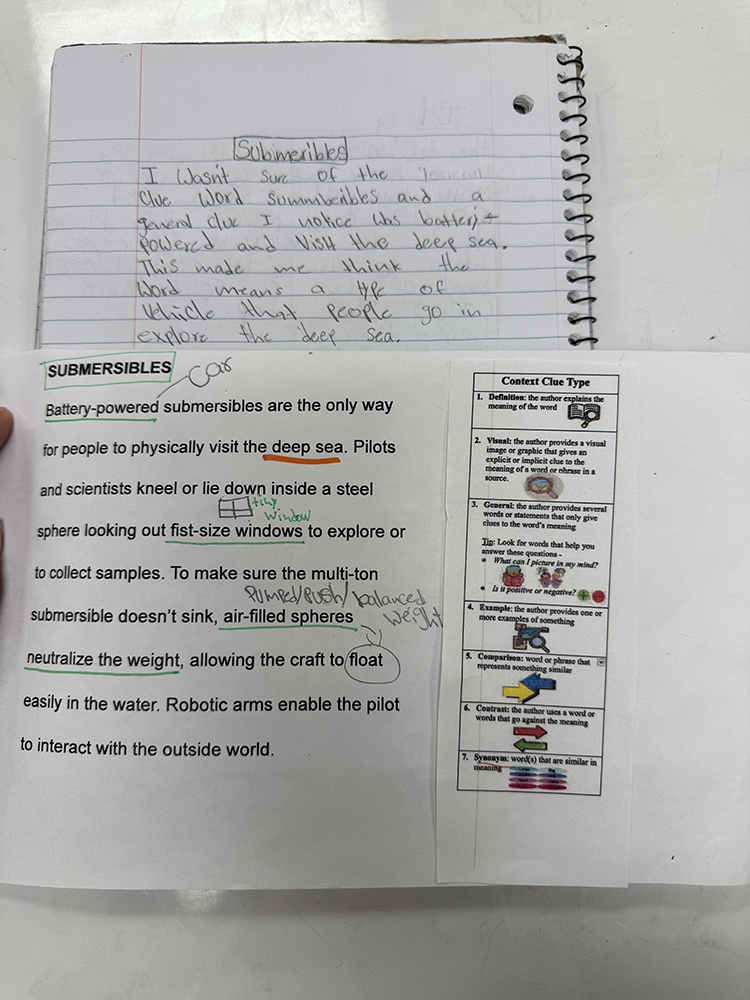
Reading response entries is an important opportunity for emergent bilinguals to reveal their understanding and can also be a tool for monitoring transfer of these reading skills (Honigsfeld, 2019). For example, this entry provides Gissela evidence of how the student is strategically applying context clues to make meaning of the unfamiliar word “submersibles.”
Provide Language-Rich Opportunities to Problem-Solve
Slowly, all of the students are starting to feel more confident in taking responsibility for figuring out the meaning of unfamiliar words. The language we use during think-alouds, the language included in the anchor chart and handout, the writing of responses—all provide rich opportunities for students to become more proficient in English. We also ask students to discuss their learning along the way. Students are grouped with intention: emergent bilinguals at emerging levels of English development are partnered with peers who have a stronger grasp of the language and can provide some support. While students collaborate, Gissela and Guadalupe lean in to check for understanding and coach at the point of need.
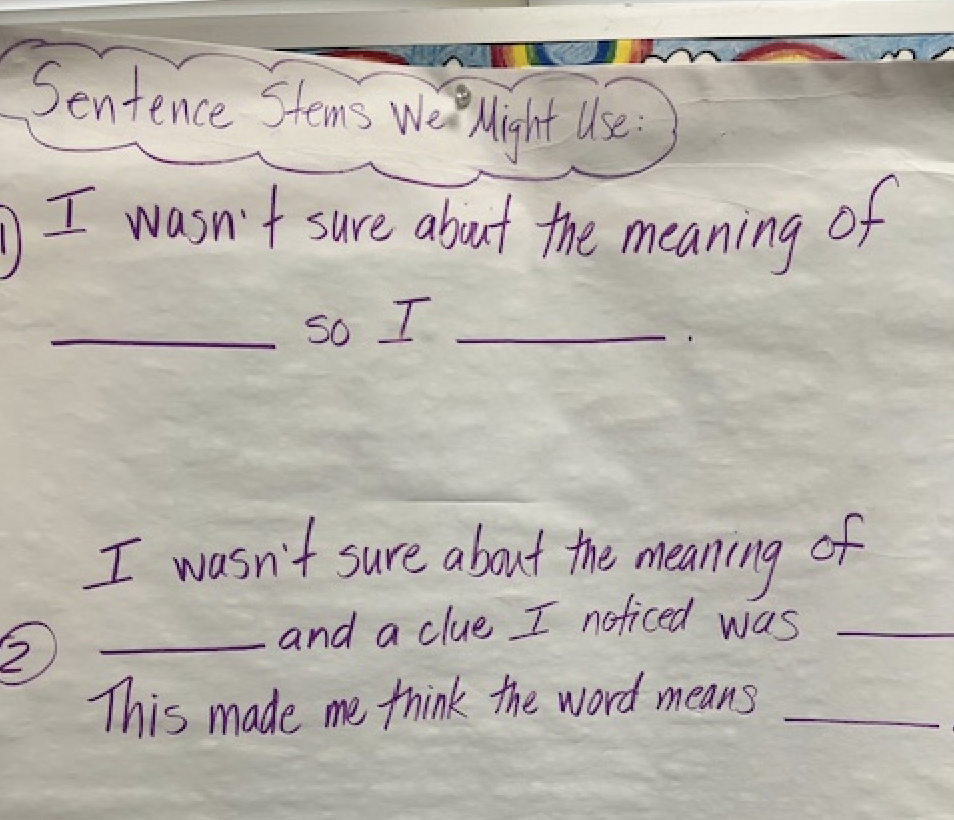
Similar to the sentence frame Gissela used to close her think-aloud, we provide frames for students to use in their discussions, such as those in the image below, posted in Guadalupe’s classroom.
We also provide collaborative language frames based on the work of Dr. Kate Kinsella (2015). While these frames are introduced during the designated English language development part of the day, they can be used across the day. Frames that are helpful during conversations about context clues include those that build or add on to what has been said, frames that seek clarification, and frames that help students paraphrase and affirm what their partners have said. Initially, the students sounded a little robotic using them, but now many weave these frames into their conversations seamlessly with hardly a thought.
Along the way we are supportive of attempts. Guadalupe reminds her students, “You don’t have to be perfect,” meaning they need to use the context clues in a way that helps them improve their understanding of the text. They may not end up knowing exactly what the word means, but having a better sense of the word’s meaning will improve their understanding of the text.
Persevere
Teaching for transfer of this skill can feel challenging at times. And yet, in these two fifth-grade classrooms, the emergent bilinguals (as well as others) have definitely developed a sense of agency by putting the routines Gissela and Guadalupe have introduced to work, actively monitoring for unfamiliar vocabulary, looking for clues, and trying to make sense of them. They are able to talk more easily about the complex texts they are reading, about what they are learning, and about how this learning has changed their understanding of the world.
References
Cummins, S. (2019). Close reading of informational sources: Assessment-driven instruction in grades 3–8 (2nd ed.). Guilford Press.
Cunningham, K. E., Burkins, J., & Yates, K. (2024). Shifting the balance: 6 ways to bring the science of reading into the upper elementary classroom. Routledge.
Fisher, D., Frey, N., & Gonzalez, V. (2025). Welcome to teaching multilingual learners!: An illustrated guide. Corwin.
Honigsfeld, A. (2019). Growing language and literacy: Strategies for English learners. Heinemann.
International Literacy Association. (2017). Second-language learners: Vocabulary and oral language development. https://www.literacyworldwide.org/docs/default-source/where-we-stand/ila-second-language-learners-vocabulary-oral-language.pdf
Kinsella, K. (2015). Cutting to the Common Core: Analyzing informational text. MinneTESOL Journal. https://minnetesoljournal.org/cutting-to-the-common-core-analyzing-informational-text/
Moses, L. (2024). Supporting multilingual learners: 50 strategies for language and literacy instruction. Heinemann.
Perfetti, C. A., & Stafura, J. Z. (2014). Word knowledge in a theory of reading comprehension. Scientific Studies of Reading, 18(1), 22–37.